Australia’s latest national waste figures, released in late September 2026, show a country producing more waste than ever while steadily improving how much of it is recovered. For builders, waste contractors, skip bin hire operators and councils, the numbers point to one clear trend: demand for robust, well-specified waste containers is not slowing down.
A Growing Waste Stream
In the 2024-25 financial year, Australia generated about 79.0 million tonnes of waste, equal to roughly 2.9 tonnes for every person. That is up from 75.6 million tonnes in 2022-23.
The waste comes from three main source streams. Commercial and industrial activity produced about 43% of the total, construction and demolition 39%, and municipal solid waste from households and councils 18%.
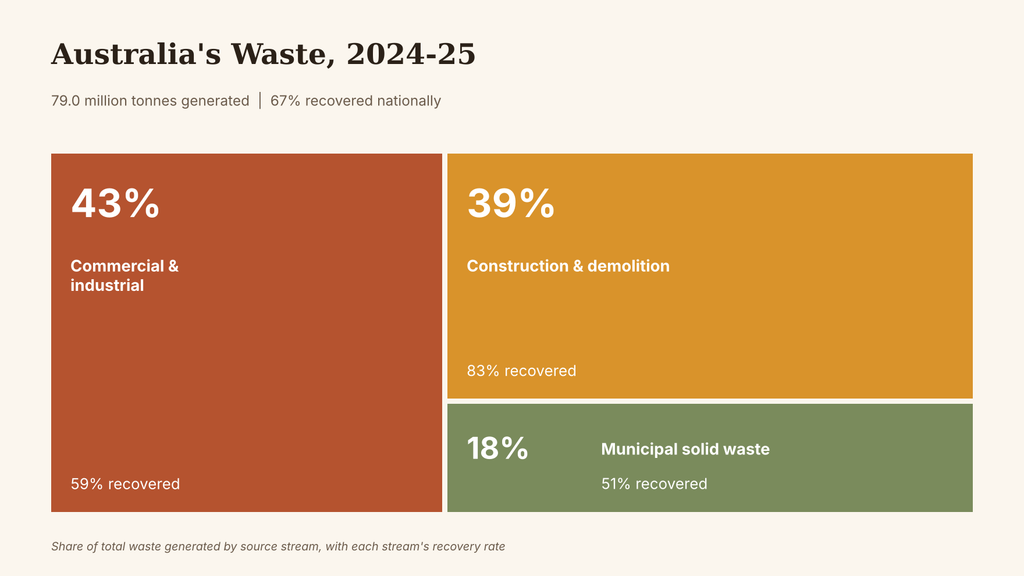
Construction and demolition accounts for nearly two fifths of Australia’s waste, and has the highest recovery rate of any stream.
Construction Leads on Recovery
Australia’s national resource recovery rate reached 67% in 2024-25, made up of 64% recycling and 3.1% energy recovery. Around 50.6 million tonnes of waste were recycled, while 25.7 million tonnes still went to disposal.
Performance varies sharply between streams. Construction and demolition waste was recovered at a rate of 83%, far ahead of commercial and industrial waste at 59% and municipal waste at 51%. Among the states and territories, South Australia led with 80%, followed by New South Wales at 74% and the ACT at 69%.
Looking at materials rather than sources, building and demolition materials such as concrete, bricks, asphalt, rubble and soil are the largest single category, at about 27.4 million tonnes in 2024-25, or roughly 1 tonne per person. This category has grown quickly in recent years: from 20.2 million tonnes in 2016-17 to 26.8 million tonnes in 2022-23, an increase of 33%, driven by strong urban development in New South Wales, Victoria, Western Australia and South Australia.
The Gap: Small Sites and Mixed Loads
Australia’s national target is an average resource recovery rate of 80% across all waste streams by 2030. At 67%, the country still has ground to make up.
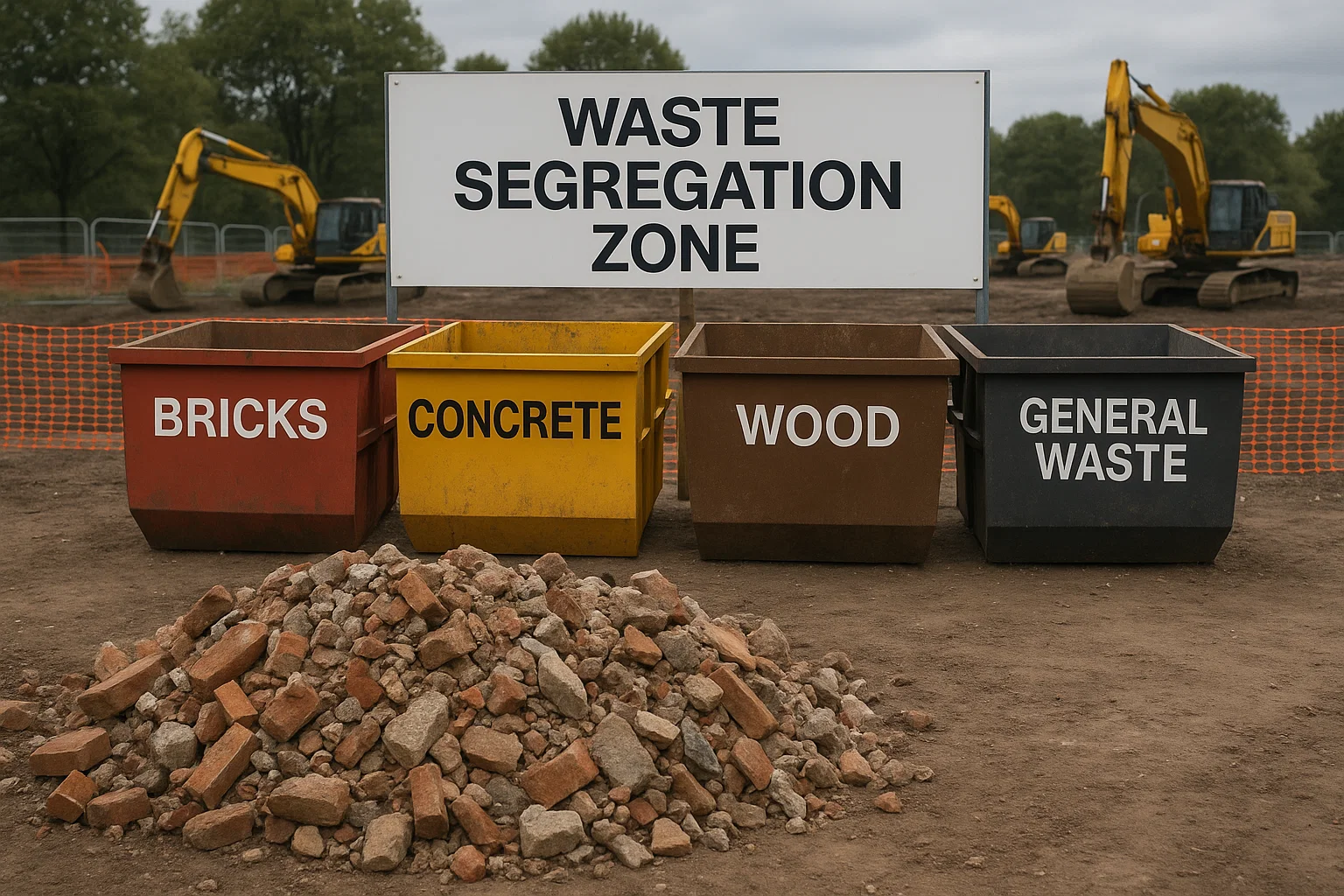
One of the clearest opportunities lies on smaller job sites. Building and demolition waste is recovered from most large development projects, but much less so from smaller ones, where mixed loads are more likely to go straight to landfill. A single general-purpose bin on a renovation or small residential build makes separation difficult. Using several smaller bins for different materials, such as clean concrete and brick, timber, metal and general waste, makes recovery far easier and often lowers disposal costs, since separated loads are usually cheaper to process than mixed ones.
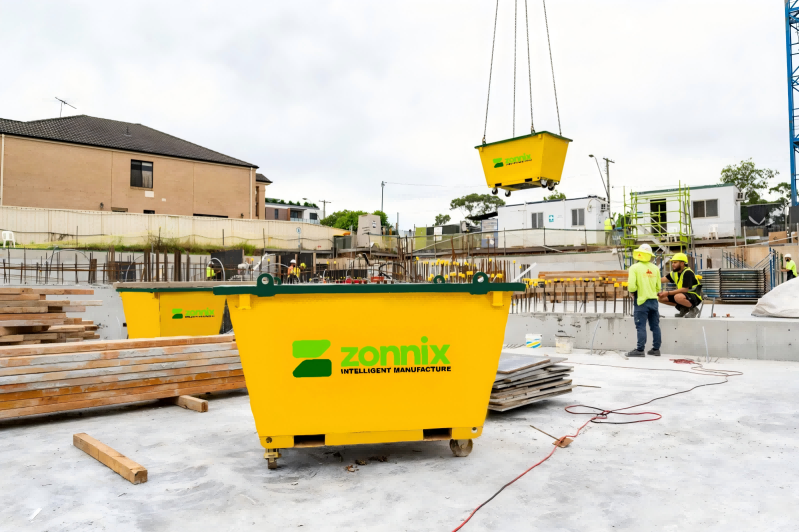
Dedicated bins for separate materials help small and medium sites improve recovery.
What This Means for Container Demand
Skip bins for residential and small commercial work. Renovations, small builds, landscaping and clean-ups make up a large share of Australia’s construction activity. Skip bins in the 2 m³ to 10 m³ range suit these jobs well, and sites that separate materials typically need more than one.
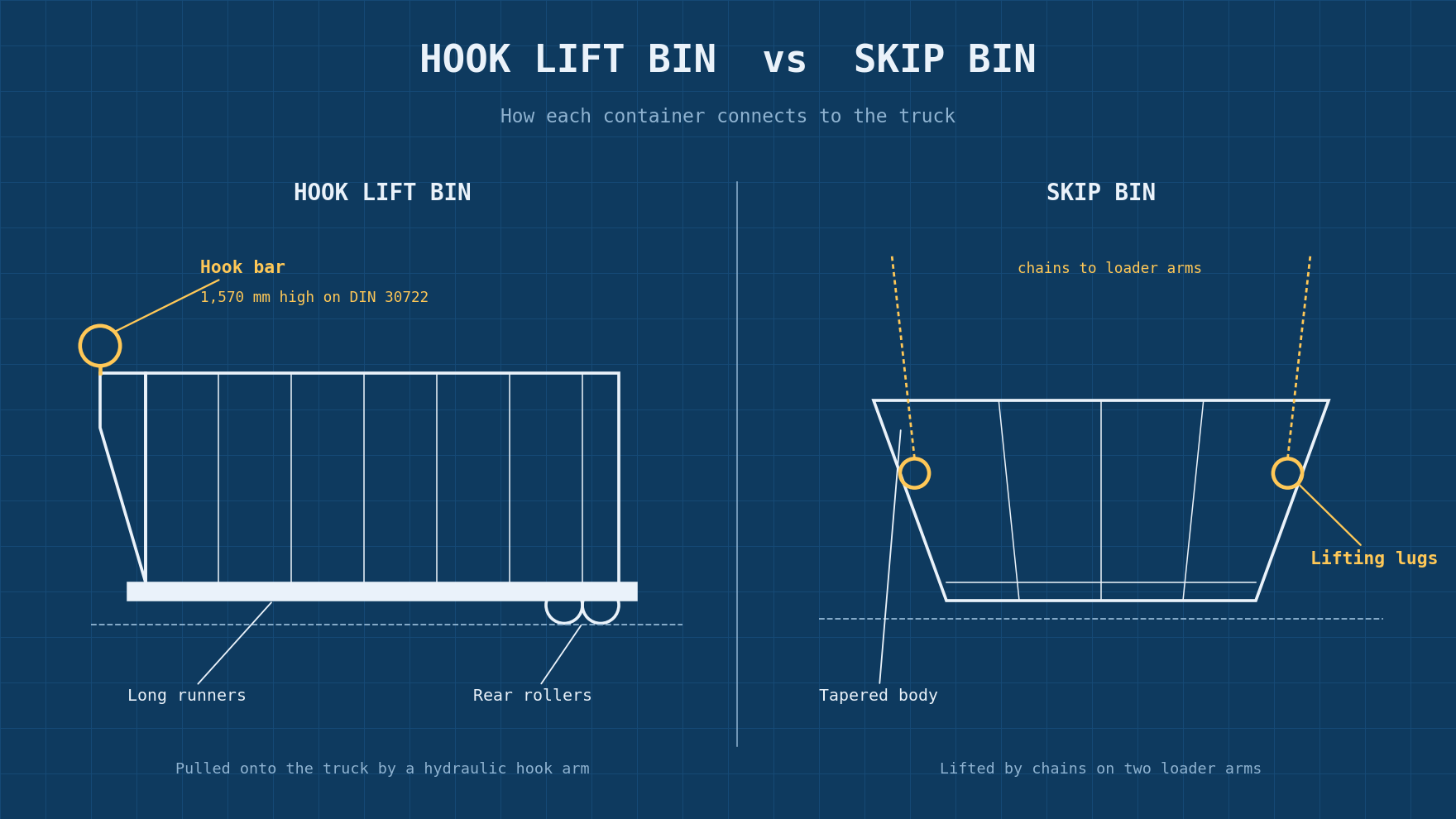
Hook lift bins for large projects and recycling facilities. On major developments, demolition projects and at resource recovery centres, hook lift bins (also known as hooklift containers) handle higher volumes and allow one truck to swap full and empty bins quickly. With the bulk of construction and demolition material now being recovered, these larger containers keep separated streams moving to recyclers efficiently.
Heavy-duty construction is essential. Concrete, brick and rubble are dense, abrasive materials. Bins handling them need thicker floor plates, reinforced sides and strong welds to survive repeated loading, lifting and tipping. A quality coating system also matters in Australia’s climate, where intense sun and coastal salt air both wear on paintwork and steel.
Compatibility with local truck fleets. Before ordering, operators should confirm that bin dimensions, lifting points and hook heights match the trucks already in their fleet, as specifications can vary between operators.
Looking Ahead
Australia’s waste volumes are still rising, and the push toward an 80% recovery rate by 2030 will keep the focus on separation at the source. For builders, skip bin operators and recycling facilities, that means planning bin fleets around more streams, heavier materials and longer service life.
Looking for skip bins or hook lift bins built for Australian job sites? Contact the Zonnix team to discuss customized waste container solutions.