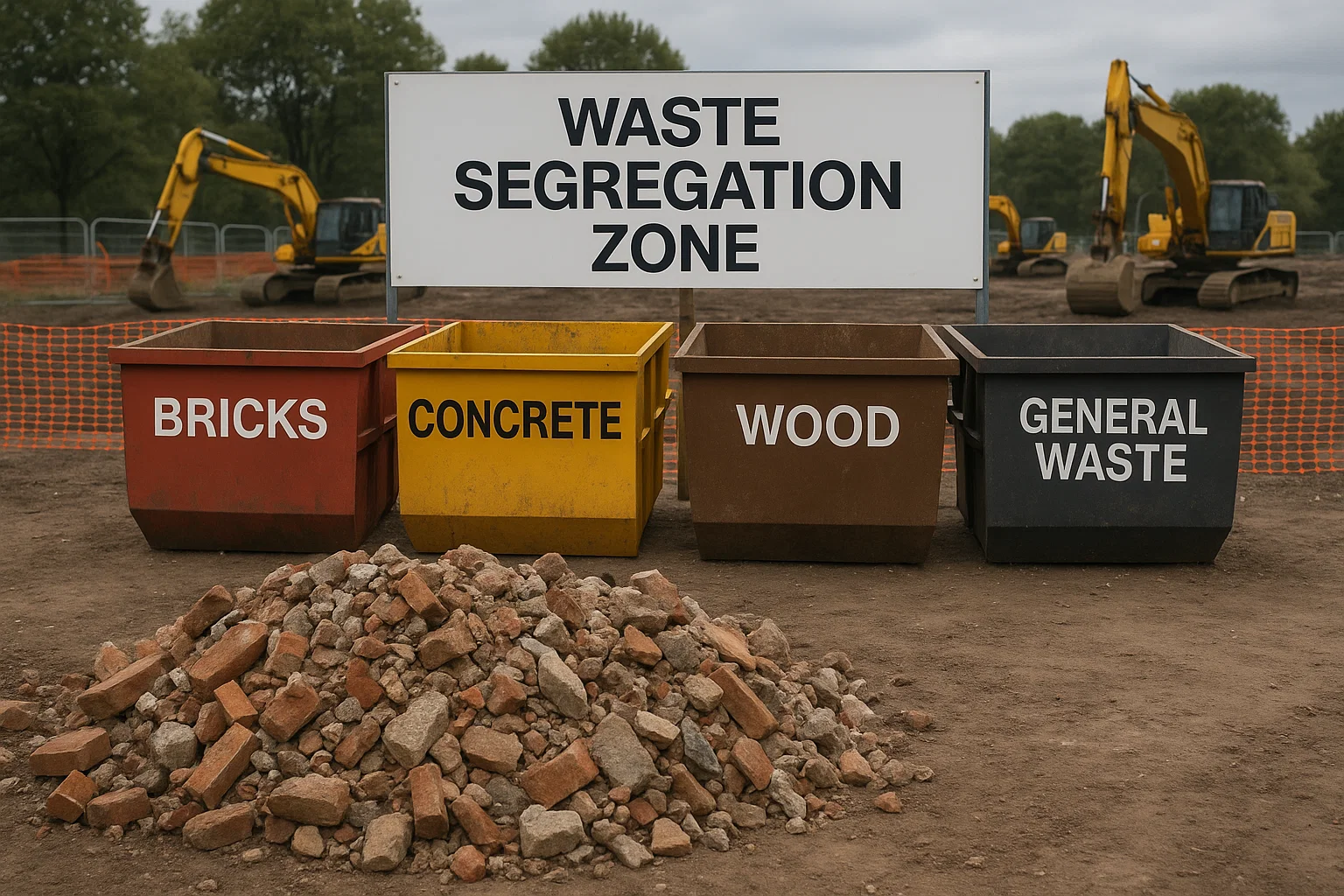
Over the past three decades, Europe has transformed the way it handles everyday waste. Landfills that once received most household rubbish now take less than a quarter of it, while recycling has more than doubled. Yet the targets ahead are more demanding still, and meeting them depends on something very practical: collecting more waste streams separately, which means more containers at every stage of the chain.
From Landfill to Recycling: A 30-Year Shift
In 2024, each EU resident generated an average of 517 kg of municipal waste, the waste that comes from households and similar sources such as shops and offices. Amounts differ widely across the bloc, from 305 kg per person in Romania to 782 kg in Austria.
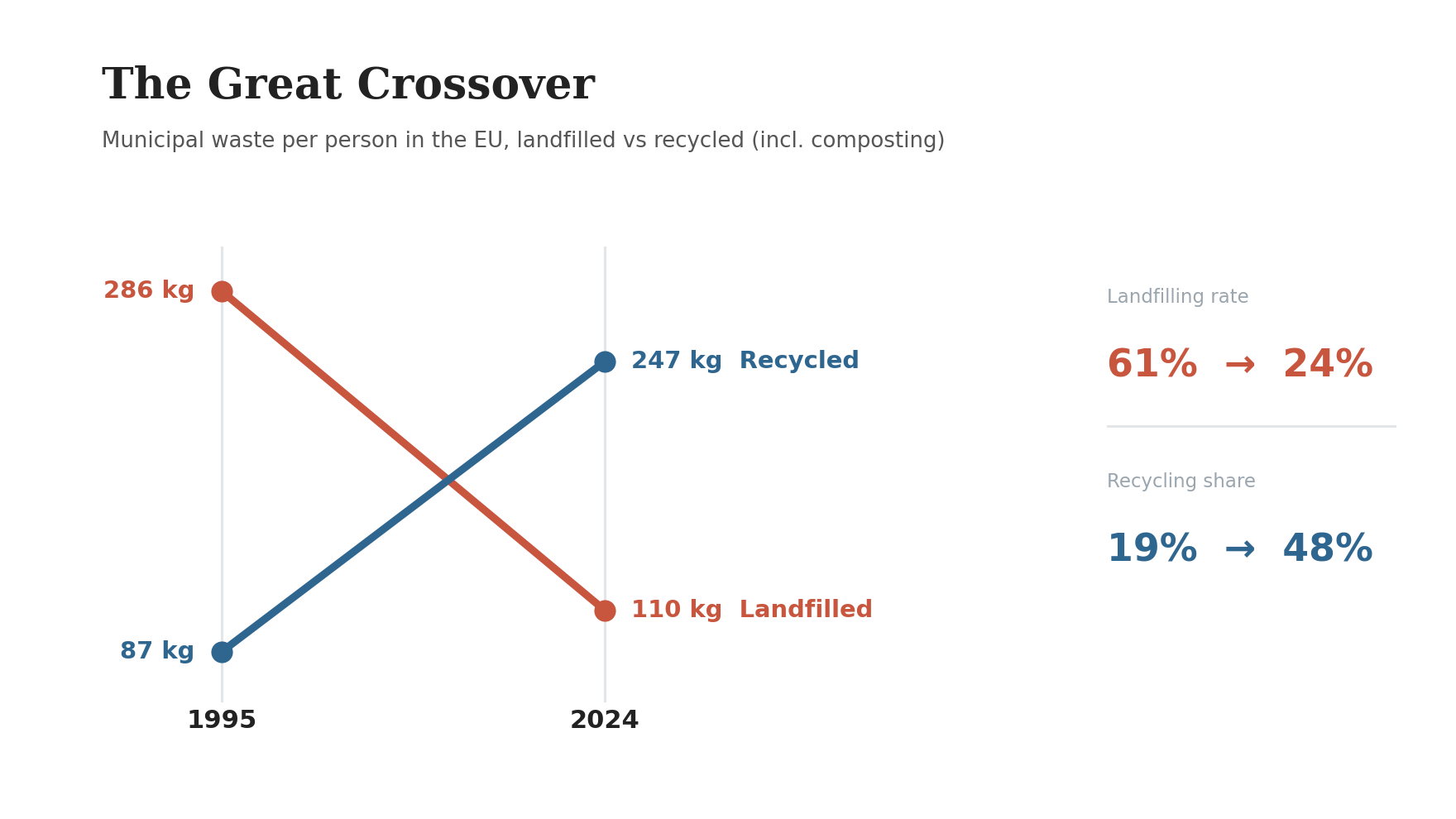
What has changed most is where that waste ends up. In 1995, the EU landfilled 286 kg of municipal waste per person. By 2024, that figure had fallen to 110 kg. Over the same period, the amount recycled and composted rose from 87 kg to 247 kg per person. As a result, the landfilling rate dropped from 61% to 24%, while the recycling share climbed from 19% to 48%.
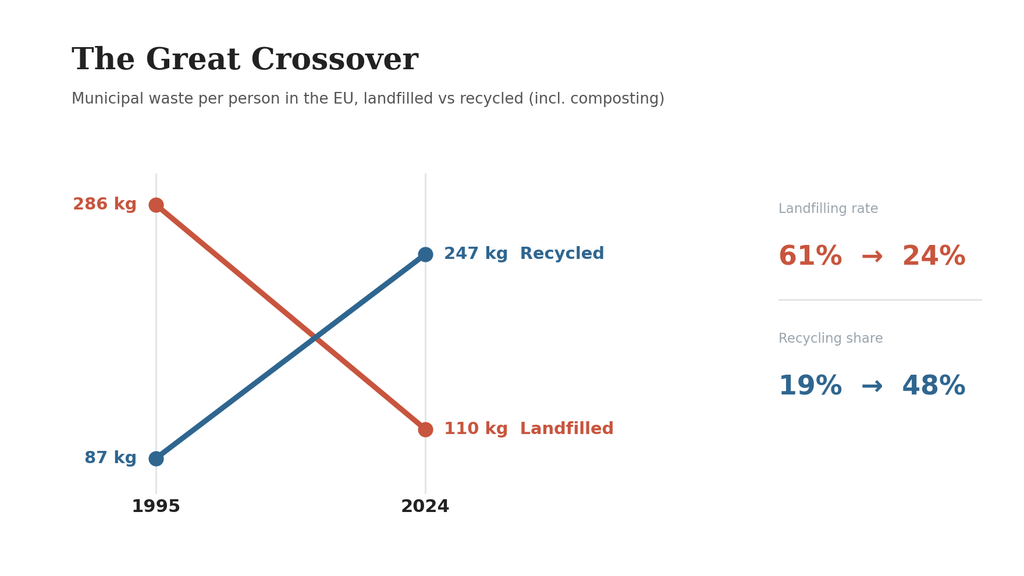
Recycling has overtaken landfill as the main destination for Europe’s municipal waste.
The Gap That Still Needs Closing
Progress has been real, but the legal targets are moving faster. Under EU waste law, member states must prepare for reuse and recycle at least 55% of municipal waste by 2025, 60% by 2030 and 65% by 2035. A separate rule limits the share of municipal waste sent to landfill to 10% or less by 2035.
Under the stricter calculation method used to check compliance, the EU average recycling rate stood at 43.3% in 2023. Some countries are already ahead: Austria reached 62.8%, followed by Luxembourg, Belgium and the Netherlands at around 55%. Others remain far behind, with five member states still below 20%.
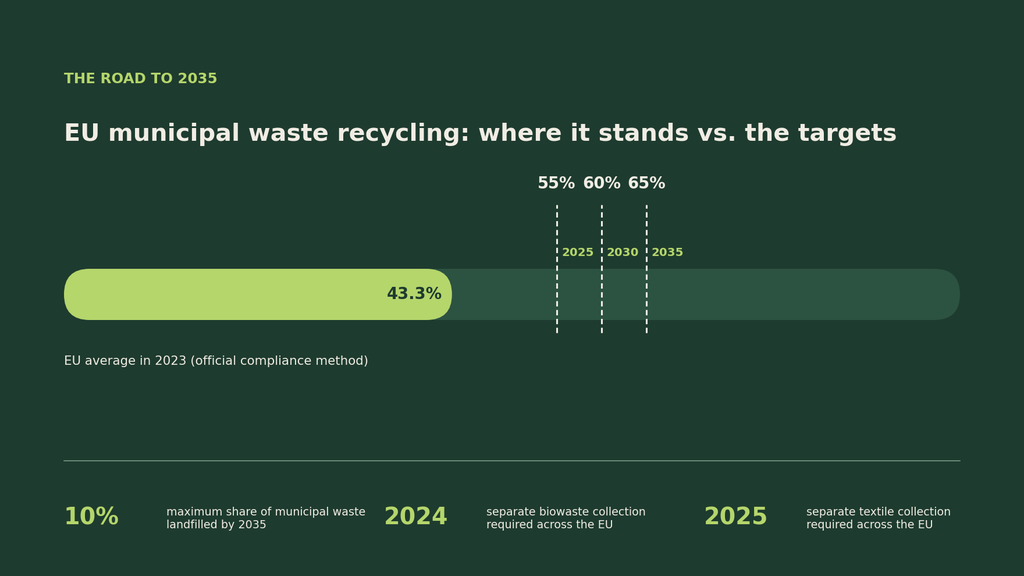
Europe’s average recycling rate still sits well below the 2025, 2030 and 2035 targets.
Why Separate Collection Is the Key
The most effective way to raise recycling rates is to keep materials apart from the moment they are thrown away. EU rules have been moving firmly in that direction. Separate collection of biowaste has been required across the EU since the start of 2024, and separate collection of textiles since the start of 2025.
The composition of municipal waste shows why this matters. In 2023, biowaste made up the largest share at 28.8%, followed by mixed waste at 20.3%. A further 14.5% fell into an “other” category that includes textiles, electronics, batteries and bulky items, while paper and cardboard accounted for 13.9%, plastic 7.5%, glass 6.3%, wood 3.4% and metals 2.9%. Every one of these streams recycles better when it is collected on its own.
What This Means for Container Demand
Stricter separation targets have a direct impact on waste infrastructure:
More recycling centres and drop-off points. Household recycling centres typically line up rows of large open containers, each dedicated to a single material such as garden waste, wood, metal, bulky items or rubble. As more materials must be kept separate, sites need more containers and faster exchange of full ones.
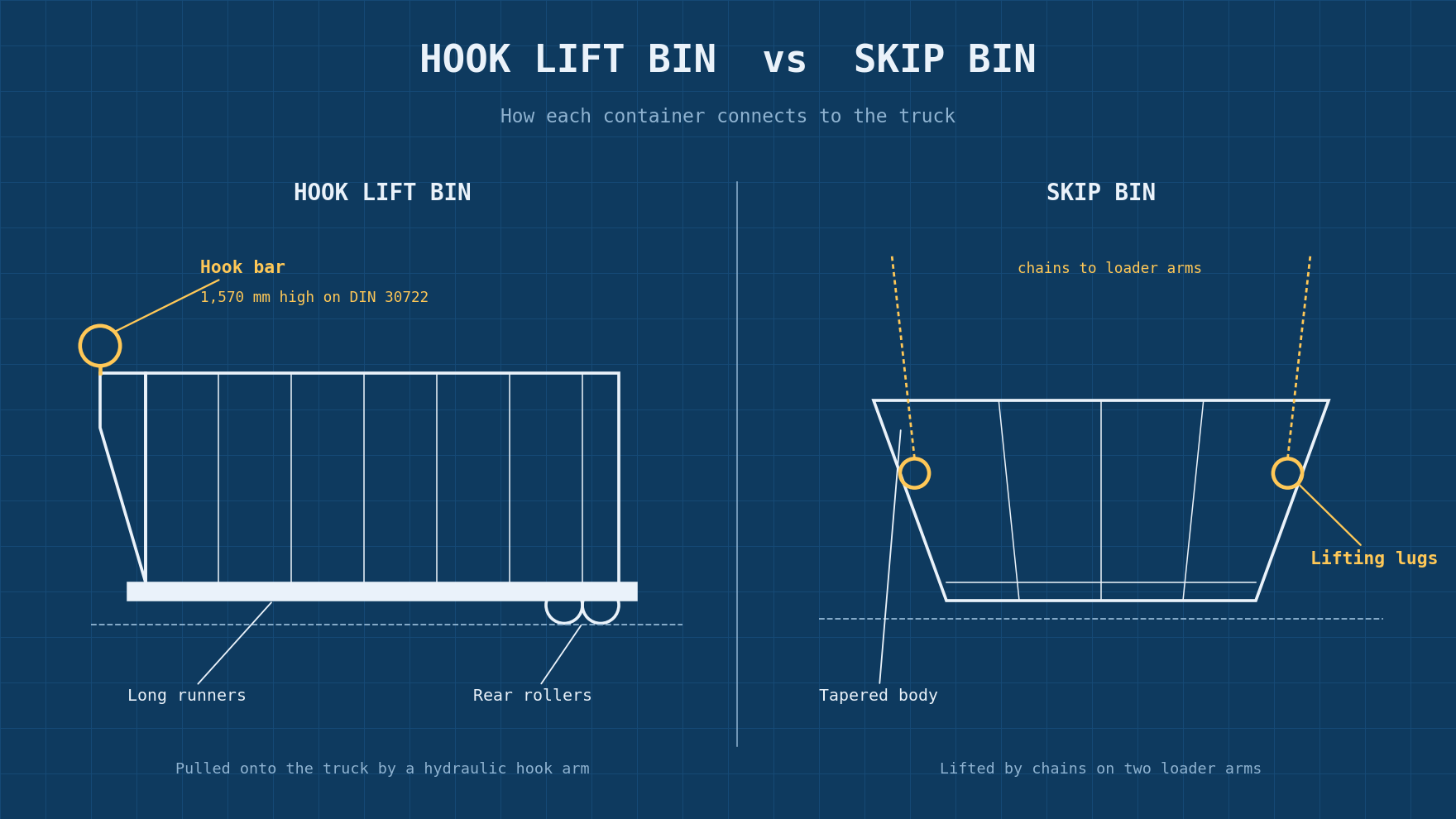
More work at transfer stations and sorting facilities. Separately collected materials often pass through transfer stations before reaching recyclers. Large-volume hook lift containers are well suited to this role, since one truck can swap full and empty containers quickly without unloading by hand.
Durability becomes a cost factor. Containers at busy sites are loaded, lifted and tipped many times a week. Heavy materials such as rubble, and wet streams such as garden waste, put steady pressure on floors, welds and coatings. Stronger steel and proper corrosion protection lower long-term replacement costs.
Flexibility for new streams. As rules expand to cover materials like textiles, operators may need containers with lids, covers or doors to protect contents from rain and keep sites tidy.
Looking Ahead
With less than ten years until the 2035 deadlines, Europe’s waste sector faces steady pressure to collect more, sort more and landfill less. For municipalities, waste operators and recycling centre managers, that means planning container fleets around separation rather than volume alone: the right number of containers, in the right sizes, built to handle heavy and frequent use.
Planning to expand your container fleet for separate collection? Contact the Zonnix team to discuss hook lift and skip bin solutions built to your specifications.