Hook lift bins and skip bins are two of the most widely used steel containers in waste management and construction. Both are open containers that are delivered empty, filled on site and hauled away. Yet they rely on completely different truck systems, come in different sizes and suit different kinds of work. Choosing the wrong one can mean paying for capacity you do not need, or running out of space halfway through a project.
This guide answers the most common questions buyers ask when comparing the two.
What Is a Hook Lift Bin?
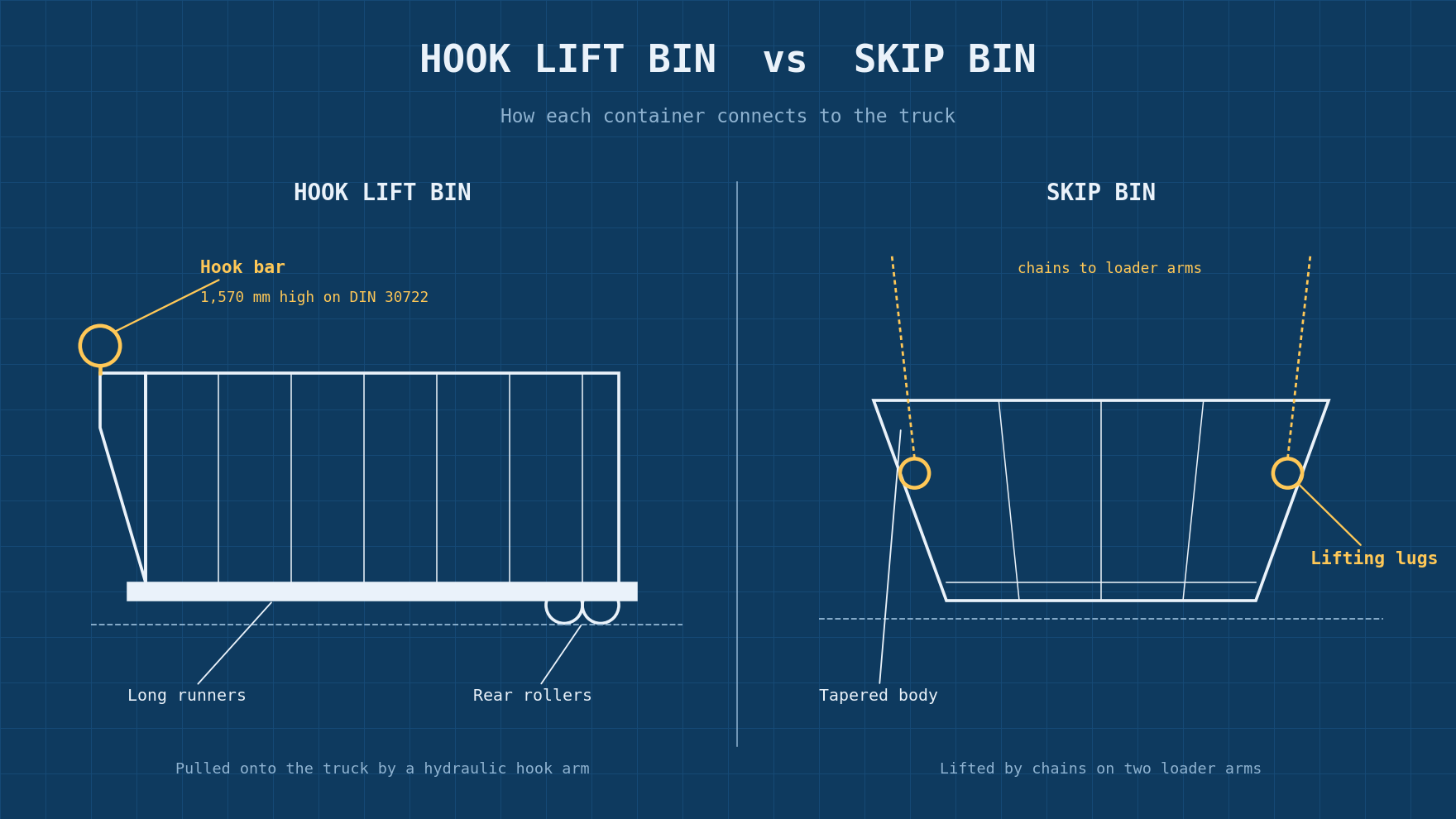
A hook lift bin is a long, rectangular container designed to be pulled onto a truck by a hydraulic hook arm. At the front of the container is a raised frame with a hook bar. The truck’s arm engages the bar and drags the container up onto the chassis, while rollers at the rear and long steel runners underneath allow it to slide smoothly on and off.
In Europe, the most widely used standard for these containers is DIN 30722, which places the hook bar at a height of 1,570 mm and covers hook lift trucks up to 26 tonnes in one part of the standard and up to 32 tonnes in another. You may also hear these containers called roll-off containers, Abrollcontainer in German-speaking countries, or haakarmbak in the Netherlands.
What Is a Skip Bin?
A skip bin is a shorter container with sloped ends, making the top wider than the base. Instead of a hook, it has a lifting lug on each side. A skip loader truck lowers two arms, attaches chains to these lugs and lifts the skip onto its bed. The same arms can tip the skip to empty it.
Skip containers for skip loader vehicles are also covered by a European standard, DIN 30720, with its first part addressing standard containers from 5 m³ to 10 m³ nominal volume. Smaller skips are also common for residential use.
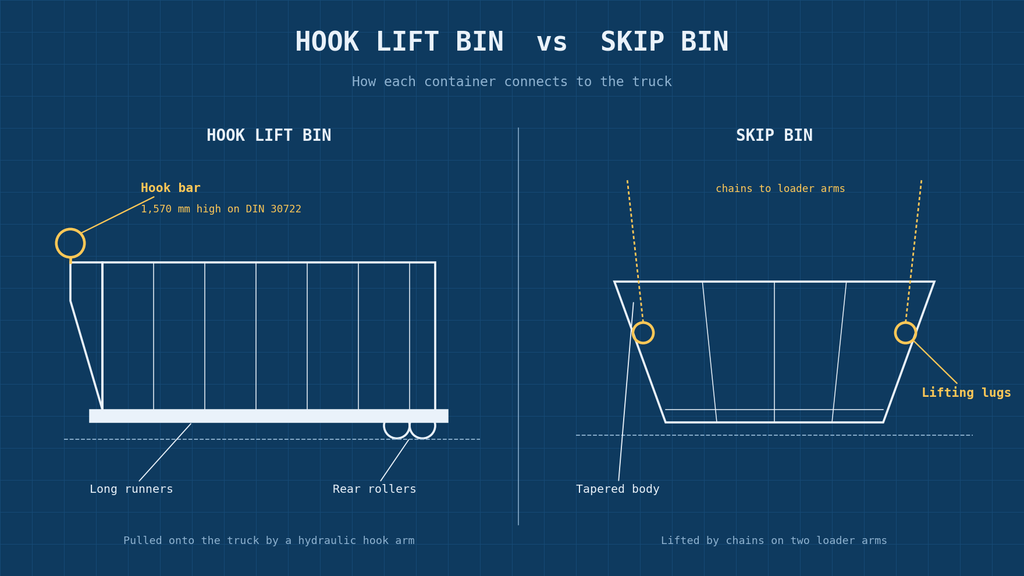
Hook lift bins connect through a front hook bar, while skip bins are lifted by chains attached to side lugs.
What Are the Key Differences?
| / | Hook Lift Bin | Skip Bin |
|---|---|---|
| Loading method | Hydraulic hook arm pulls container onto truck | Two loader arms lift the container by chains |
| Shape | Long, rectangular, straight sides | Compact, tapered ends |
| Typical capacity | Roughly 5 m³ to over 40 m³ | Roughly 2 m³ to 10 m³ |
| Best for | Large volumes, heavy or bulky waste | Smaller volumes, tight sites |
| Common options | Rear doors, lids, tarpaulins, ribbed sides | Doors, lids, galvanizing, crane rating |
Which One Should You Choose?
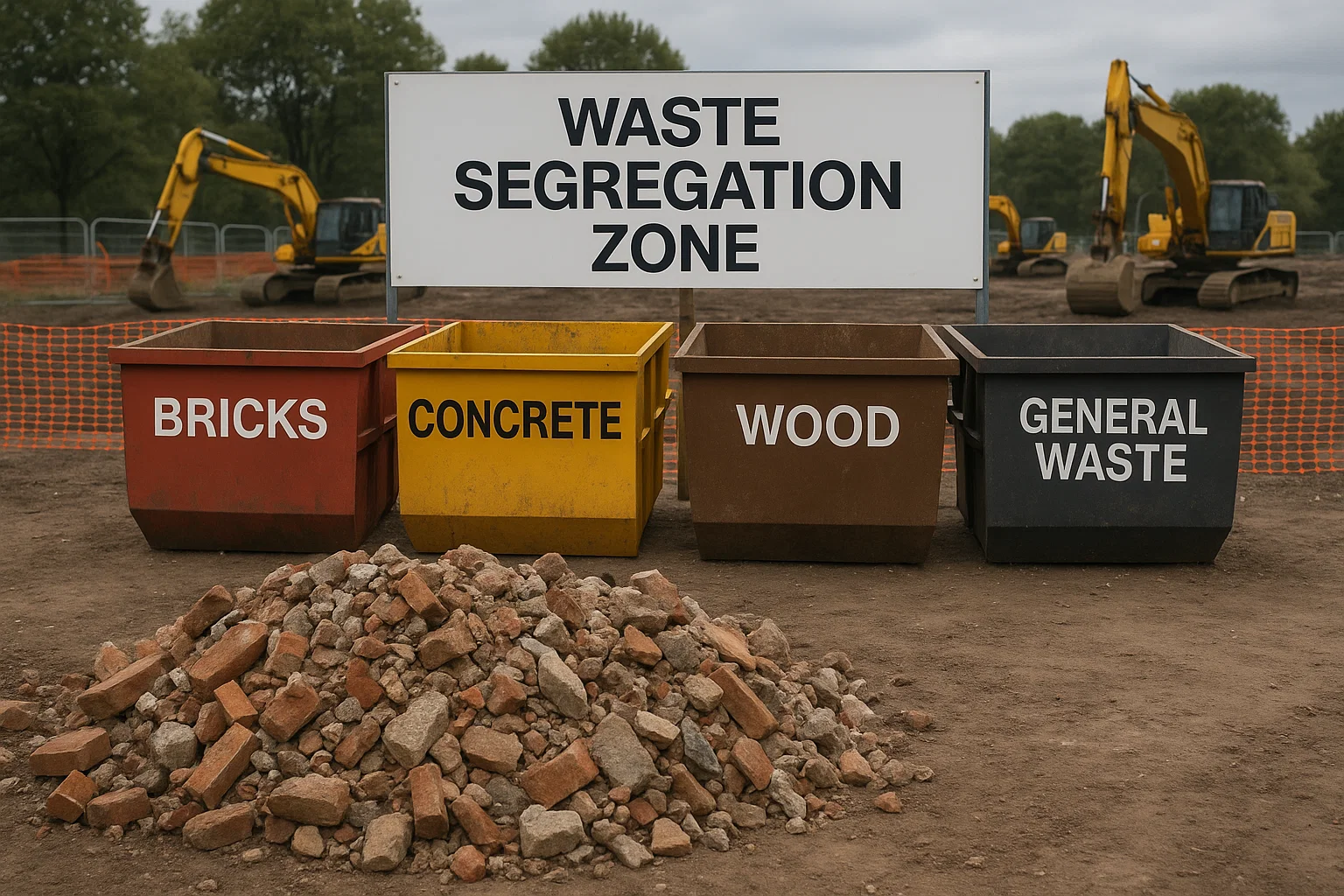
Choose a skip bin if you are working on a home renovation, garden clean-up, small commercial fit-out or any site with limited space. Skips have a small footprint, can be placed on driveways or narrow streets, and are cost-effective for moderate waste volumes.
Choose a hook lift bin if you are handling large volumes on construction or demolition sites, at recycling yards, transfer stations or industrial facilities. A single hook lift truck can drop off an empty container and collect a full one in minutes, which keeps busy sites running without long waits. The larger capacity also means fewer trips for bulky materials such as timber, scrap metal or mixed demolition waste.
For projects that separate materials on site, many operators combine both: large hook lift bins for high-volume streams like rubble, and skips for smaller streams such as metal or plasterboard.
Can a Hook Lift Truck Carry a Skip Bin?
No. The two systems are not interchangeable. A hook lift truck needs a hook bar and runners to engage the container, while a skip loader needs side lugs. Even among hook lift containers, the hook height must match the truck’s arm, so it is important to confirm your fleet’s specification before ordering.
What Should You Check Before Ordering?
Before buying either type, confirm the following:
- Truck compatibility: hook height and runner spacing for hook lift bins, lug position and size for skip bins.
- Capacity: match the volume to your typical load and the weight limit of your truck.
- Steel and plate thickness: heavy materials like concrete need a thicker floor and reinforced sides.
- Coating: a proper primer and top coat system protects against corrosion in outdoor use.
- Accessories: doors, lids, tarpaulin systems or forklift pockets, depending on how the bin will be loaded and emptied.
Getting these details right from the start extends the working life of the container and avoids costly compatibility problems later.
Need hook lift bins or skip bins built to your truck specifications? Contact the Zonnix team for customized container solutions.