
Steel waste bins live a hard life. They sit outdoors for months at a time, get loaded with wet, abrasive and sometimes corrosive material, and are lifted, dropped and tipped over and over again. In that environment, the surface finish is what stands between the steel and rust.
The two main options are hot dip galvanizing and a multi-coat paint system. Both work, but they protect steel in different ways, cost different amounts and suit different conditions. Here are answers to the questions buyers ask most often.
How Does Each Finish Protect the Steel?
Painted bins rely on a barrier. A quality system uses a zinc-rich epoxy primer, which bonds to the blasted steel and adds some corrosion resistance, followed by a tough top coat such as polyurethane. As long as the coating stays intact, moisture and oxygen cannot reach the steel.
Hot dip galvanized bins are dipped in molten zinc after fabrication. The zinc bonds metallurgically with the steel and coats every surface, including inside corners, seams and the underside of the floor. Zinc also acts as a sacrificial metal: if the coating is scratched, the surrounding zinc corrodes first and continues to protect the exposed steel at the damaged spot.
That difference matters for waste bins. On a painted bin, a deep chip from a dropped load can let rust start at the damage and creep under the surrounding paint. On a galvanized bin, small scratches are protected by the zinc around them.
How Long Does Galvanizing Last?
The answer depends mainly on the environment. The international standard ISO 9223 classifies atmospheres into six corrosivity categories, from C1 (very low) to CX (extreme). The first-year corrosion rate of zinc rises sharply across these categories, from 0.7 to 2.1 µm per year in a C3 environment to 2.1 to 4.2 µm in C4, 4.2 to 8.4 µm in C5, and as much as 8.4 to 25 µm in CX conditions. Corrosion rates usually slow down after the first year of exposure.
Coating thickness depends on the steel. Under the galvanizing standards used in Europe, the UK, Australia and New Zealand, steel over 6 mm thick must carry a minimum average coating of 85 µm, while steel over 3 mm and up to 6 mm must carry 70 µm. In North America, galvanizing of fabricated steel products is covered by ASTM A123. Since most skip bin and hook lift bin plates fall into the 3 to 6 mm range, a 70 µm coating is a useful reference point.
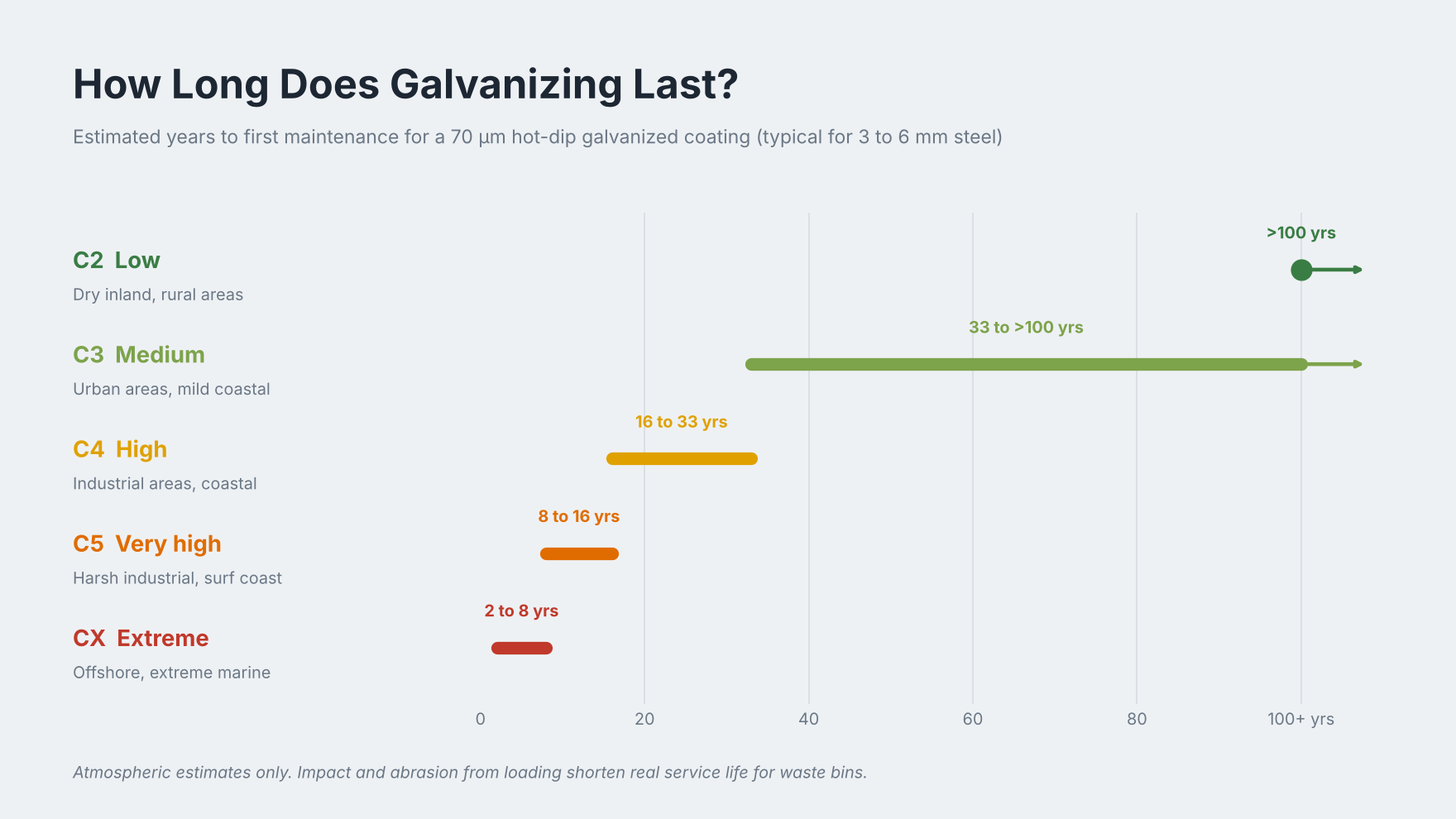
For a 70 µm coating, the estimated time to first maintenance ranges from more than 100 years in a low-corrosivity C2 environment to 33 to more than 100 years in C3, 16 to 33 years in C4, 8 to 16 years in C5 and just 2 to 8 years in CX.
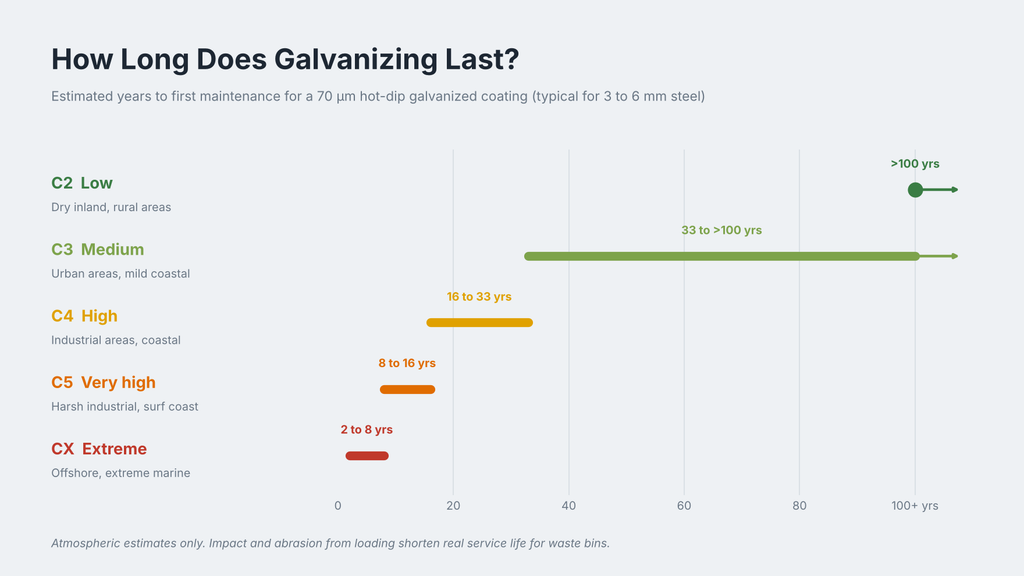
Estimated life of a 70 µm galvanized coating drops sharply in more corrosive environments.
It is important to read these figures as atmospheric estimates. A waste bin also suffers impact, scraping from loaders and abrasion from rubble, all of which wear the coating faster than weather alone. Even so, the comparison shows how strongly location affects coating life.
When Is Galvanizing the Better Choice?
Galvanizing is generally worth the investment when:
- Bins operate near the coast, where salt in the air speeds up corrosion. This is common across much of Australia, the UK and coastal North America.
- Bins handle wet or corrosive loads, such as green waste, food waste, compost or scrap metal with residues.
- Bins stay on site for long periods with little chance for maintenance or repainting.
- Low lifetime cost matters more than upfront price. Galvanizing usually costs more at the start but needs little maintenance afterwards.
When Is a Painted Finish the Better Choice?
A quality paint system remains a strong choice when:
- Branding matters. Paint can be applied in any colour, so bins can carry a company’s corporate colours, which makes a fleet instantly recognisable on the street and on job sites.
- Bins work in drier, inland conditions, where corrosion pressure is lower.
- Budget is tight at purchase. A painted bin generally costs less up front.
- Repairs need to be easy. Damaged paint can be cleaned and touched up on site.
Painted bins also have no practical size limits, while galvanizing depends on the size of the zinc bath available, which can restrict very large containers.
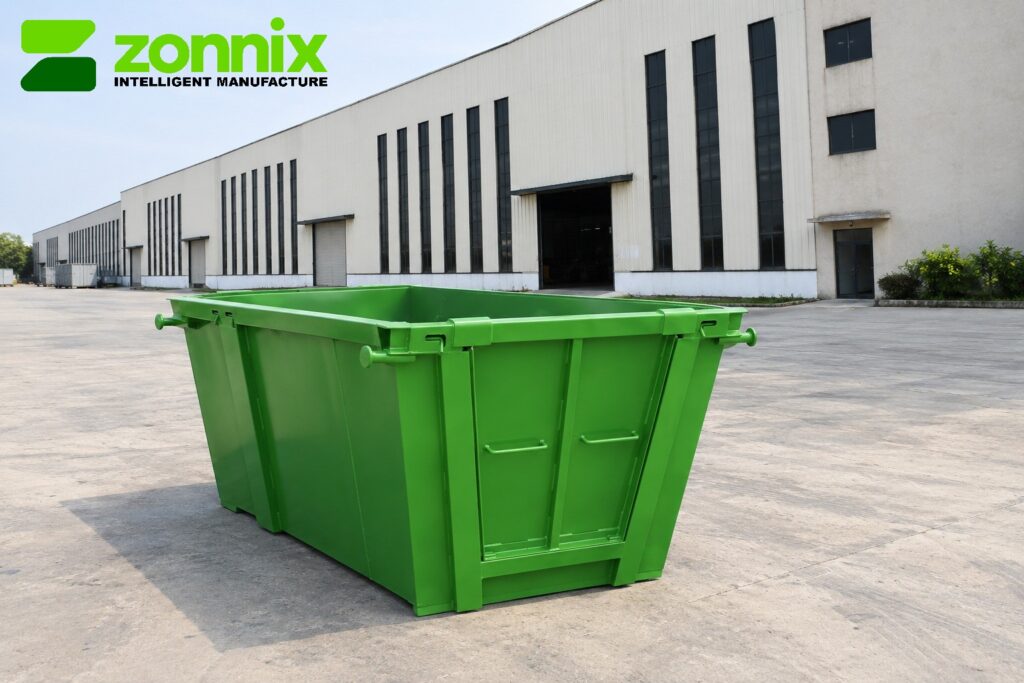
Galvanized skip bins are popular for coastal sites and wet waste streams.
Can You Have Both?
Yes. A “duplex” system combines hot dip galvanizing with a paint top coat. The zinc provides corrosion protection underneath, while the paint adds colour and an extra barrier that slows the loss of zinc. Duplex systems are typically used where both long life and branding matter, for example on municipal fleets in coastal cities.
What to Ask Your Supplier
Before ordering, check these points regardless of the finish:
- Surface preparation: paint performance depends heavily on proper abrasive blasting before priming.
- Coating system and thickness: ask for the number of coats and the dry film thickness for paint, or the coating standard for galvanizing.
- Weld quality: seams should be continuous and smooth, since gaps trap moisture and start corrosion.
- Drainage: small drain holes in the right places stop water pooling inside the bin.
- Touch-up guidance: know how to repair damage so small chips do not become large rust patches.
Need skip bins or hook lift bins with a painted, galvanized or duplex finish? Contact the Zonnix team to discuss the right coating for your operating conditions.